Key Takeaways
- Chores build essential academic skills like executive functioning, sequencing, and the ability to follow multi-step instructions.
- Regular participation in household tasks strengthens responsibility, confidence, empathy, and a sense of belonging.
- Everyday chores teach practical life skills—time management, budgeting basics, organization, and problem-solving—that schools often don’t fully cover.
- When framed positively and done consistently, chores become a powerful “hidden curriculum” that supports both education and character development.
This week, I implemented a pre-Christmas season chore system in our home: a way to help keep us all sane and the house at least a little bit under control with all the holiday craziness!
My kids have always had regular chores, but this was more extensive and official. They eagerly jumped into the chore distribution process, happily doling out every task and enthusiastically strategizing how to accomplish their lists.
“This will go well!” I thought to myself as I observed my happy little crew. I felt just a twinge of sentiment as I fantasized, “They finally understand how pleasant life can be with a clean, orderly home!”
However, my fancy and their enthusiasm were both short-lived.
Reality proved to be less exciting and more difficult than the children’s grand plans had accounted for. While I had plenty of willing volunteers in the beginning, I ended up having to hunt children down and enforce chore time amongst whines and protests.
But, I know I’m not alone!
Most parents have had that moment: you call a child to help with something simple, and they groan as if you’ve asked them to move a mountain. But here’s the secret most kids don’t realize (and many adults forget): those small, everyday tasks aren’t just about keeping the house from falling apart.
They’re powerful teaching tools.
In fact, researchers are increasingly finding that chores build many of the same cognitive and emotional foundations that make kids successful learners. And unlike worksheets, apps, or enrichment programs, the educational value of chores is baked into real life.
When children take responsibility for the work of the home, they practice problem-solving, develop executive functioning, build confidence, cultivate a sense of peace in their home, and learn what it means to contribute to a community, all without a single flashcard.
Before long, you start to see it: a child who can manage a morning routine is better prepared to manage a school routine. A kid who can follow multi-step chores can follow multi-step instructions.
A young person who feels they matter at home carries that sense of purpose into every other area of life. In short, chores are one of the simplest, most overlooked ways to strengthen a child’s education, and there’s no new curriculum required.
Chores Strengthen the Skills Behind Academic Success
While there are many educational benefits to children doing chores, let’s first examine the academic advantages.
An extensive 2020 longitudinal study following nearly 10,000 children found that young kids who completed simple household chores not only demonstrated greater academic competence by third grade, but also reported higher life satisfaction, stronger peer relationships, and greater confidence in school-related tasks.
The study concluded that “Compared with children who regularly performed chores, children who rarely performed chores had greater odds of scoring in the bottom quintile on self-reported prosocial, academic ability, peer relationship, and life satisfaction scores…Performing chores with any frequency in kindergarten was associated with improved math scores in the third grade.”
These are remarkable findings, considering the simplicity of the tasks involved: basic tidying, helping with meals, or assisting with household routines.
Other studies show the same: chores build executive functioning — the skills kids need to plan, focus, regulate emotions, follow instructions, and juggle tasks. These functions are strongly predictive of academic achievement in later grades.
As the study authors note, everyday tasks like cleaning and organizing train the brain to “sequence, prioritize, and inhibit impulses,” essential skills for reading comprehension, writing, mathematics, and functioning well in group learning environments.
Chores Develop Responsibility, Empathy, and Confidence
Real-world experience is one of the most practical ways to educate a child. It develops a realistic foundation to build on, and fosters critical thinking, responsibility, and the confidence to tackle challenges independently.
Chores offer something no worksheet or enrichment class can: the experience of contributing meaningfully to the household. Children who regularly participate in chores develop a grounded sense of belonging and self-worth.
A Harvard child-development summary explains this beautifully. “When children do chores, they learn that their contributions matter and that they are part of something bigger than themselves.”
As University Hospitals’ pediatric behavioral specialists point out, “Chores aren’t just about keeping a clean home. They teach kids confidence, empathy, emotional regulation, and executive functioning.”
These abilities form the bedrock not only of personal character but also of successful learning in group settings, extracurricular activities, and, eventually, adulthood.
Chores Reinforce Practical Knowledge Every Child Needs
Regardless of how rigorous an academic program may be, it’s likely to leave gaps here and there in life readiness. Household responsibilities can help fill those gaps by developing:
- Time management
- Task sequencing
- Basic economics (budgeting, grocery planning, understanding costs)
- Health and nutrition awareness
- Maintenance and problem-solving skills
- Project management (especially with pets, gardens, shared spaces)
These skills naturally integrate into everyday home life. Real-world learning builds character, critical thinking, and self-reliance.
Chores provide that connection.
Age-Appropriate Chores: Grounded, Realistic, Achievable
The American Academy of Child & Adolescent Psychiatry stresses starting small and building consistency.
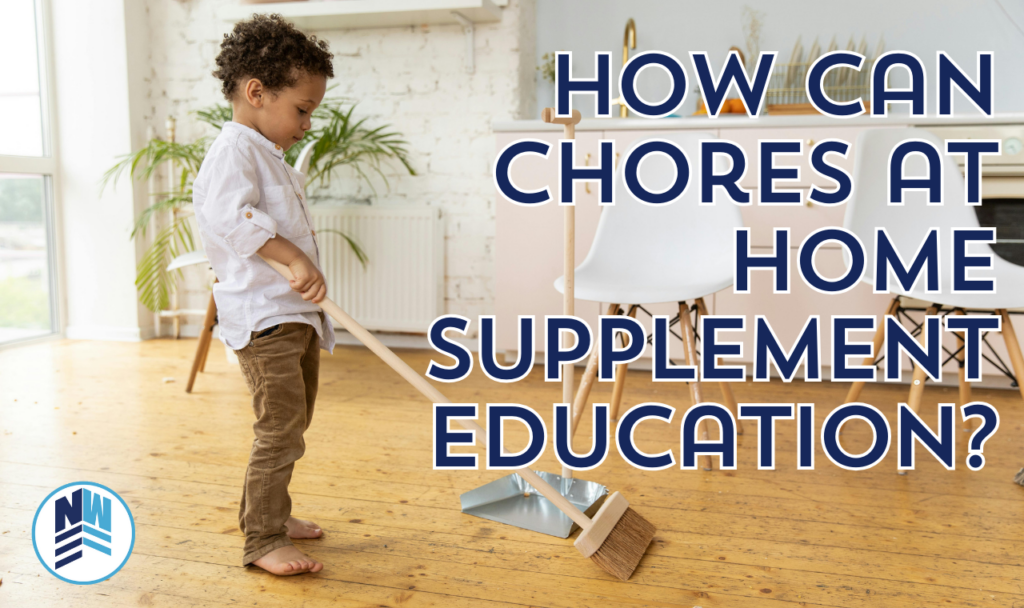
They suggest simple tasks, like putting toys away or setting the table, for children as young as three. By age six and up, kids can tackle sweeping, folding towels, and more. According to their charts, around ten-year-old kids are ready to accomplish more advanced tasks, such as simple meal prep and doing laundry.
By the time they hit the teen years, kids should be cooking full meals, mowing the lawn, or overseeing younger siblings.
Remember: the goal is not perfection, but participation. Kids are learning how to share in the household, follow step-by-step cleaning routines, and think through problems on their own. They are contributing to the family economy and getting an education to boot!
Keeping Chores Positive Instead of Punitive
Experts strongly caution parents against using chores as punishment. Dr. Angela Son of CSU Fullerton explains, “Chores should not be used to penalize children. They should be a way to practice responsibility and participation in family life.”
When chores are framed as a contribution, not a consequence, kids feel valuable rather than burdened.
And interestingly, consistency matters more than intensity. Even short tasks, such as a 3-minute bed-making routine or a 5-minute tidy up, build lifelong habits when part of a daily rhythm.
The Hidden Curriculum of Family Work
A well-rounded education is more than academics. It includes character, confidence, responsibility, and the internal strength to manage one’s life and commitments. As we settle into
this pre-Christmas chore experiment, my kids aren’t instantly turning into cheerful housekeeping elves, but something good is happening.
Every time they show up, even reluctantly, they’re building skills that matter far more than a spotless living room: perseverance, teamwork, responsibility, and the confidence that comes from real contribution.
That’s the quiet magic of chores. They’re ordinary, but they teach extraordinary lessons. Whether kids learn at school, at home, or somewhere in between, the household is still their first classroom. And these daily tasks? They shape capable, grounded young people who can handle life with a little more grit and a lot more purpose.
No fancy program required — just a family showing up together, one small chore at a time.