
If there’s one myth about math that has done more damage to student confidence than anything else, it’s the idea that kids need to memorize steps before they can truly understand math.
In reality, the opposite is true.
Children learn math the same way they learn language: they make sense of it first. Understanding comes before memorizing.
And nowhere is that more important than with the four basic operations.
“Learning is supported when instruction on procedures and concepts is explicitly connected in ways that make sense to students,” notes the National Council of Teachers of Mathematics. “When students use a procedure they do not understand, they are more likely to make errors and fail to notice when the answer does not make sense.”
Strong conceptual understanding is what makes procedures meaningful, efficient, and long-lasting—not the other way around.
These operations form the building blocks for all later mathematical reasoning, as children move from concrete experiences to more abstract understanding over time.
So let’s break down what each operation really means, and why teaching the action, not the algorithm, is the secret to building true math literacy.
Addition: Putting Things Together
Addition is the math version of “Here, have some more.”
Kids naturally understand this. If a child has three crackers and you hand them two more, they don’t need a worksheet to know they now have five.
But here’s the key: they understand this through real experiences, not symbols.
When children combine objects, count them, touch them, and talk about what they’re doing, they’re wiring their brains for future number sense.
Researchers in education emphasize that hands-on experiences with quantities lay the groundwork for later mastery of math symbols.
Once they grasp the action of combining, the symbol “3 + 2” feels logical rather than magical.
Subtraction: Taking Away
Subtraction is the next natural leap: something is taken away, so now there’s less.
Kids see this everywhere:
- They eat two cookies from their plate.
- They take one toy out of the bin.
- They remove blocks from a tower.
Their brain learns “take away” long before they ever see a minus sign.
Problems start when teachers teach subtraction as an abstract procedure, especially with regrouping (i.e., “borrowing”), before kids understand what taking away means.
Procedures built on confusion often don’t stick in the long term.
Why Understanding Changes How Students Think
When students truly understand what an operation represents, they are no longer limited to memorized steps. They begin to recognize patterns, make connections between problems, and choose strategies based on meaning rather than recall.
This is where math shifts from isolated skills to flexible thinking. The same idea- addition, subtraction, multiplication, or division- can show up in many different forms. Students who understand the structure of an operation can identify it even when the context changes.
This ability to transfer knowledge is what separates procedural familiarity from mathematical thinking.
Multiplication: Equal Groups
Multiplication is often framed as “faster addition,” but that misses its essential meaning. Multiplication is combining equal groups.
That’s it.
Four groups of three.
Two packs of six.
Five rows of four.
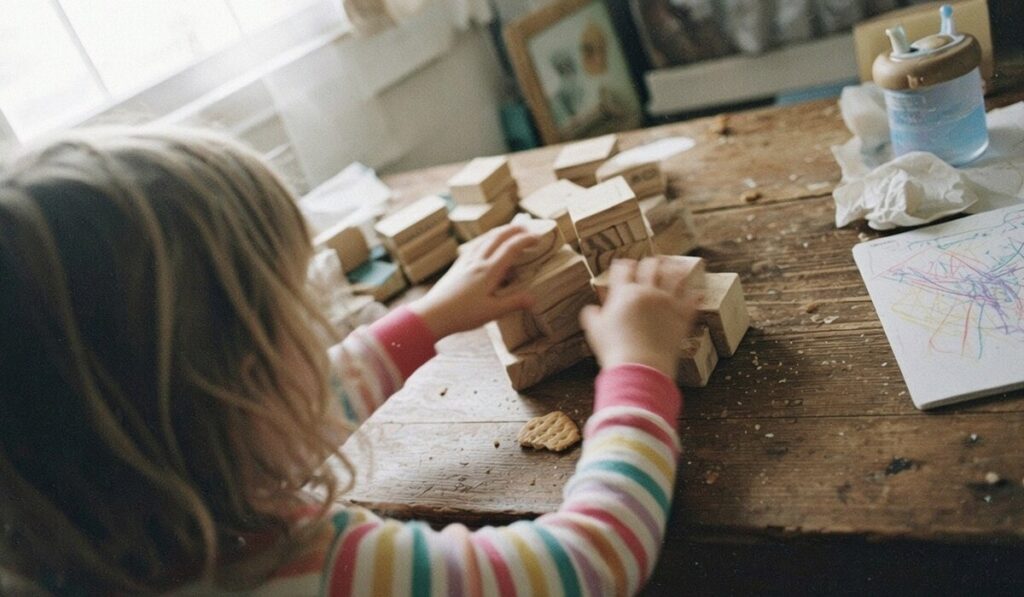
When children arrange objects into equal groups (cups, blocks, snacks), they’re building an intuitive sense of multiplication.
Without that grounding, times tables become disconnected facts rather than tools for thinking. Students may memorize that 7 × 8 = 56, but without understanding, they often cannot visualize it or apply it to real-world problems.
Grasping how an operation works helps students apply it to different kinds of problems.
Division: Sharing and Splitting
Division might be the most misunderstood operation, especially among adults who were taught tricks rather than meaning.
But the core idea is simple:
- Finding how many equal parts there are
- Splitting something into equal parts
Kids get this intuitively. Ask them to divide 12 crackers between 3 siblings, and they’ll do it with surprising precision.
This real-life division is what grounds later symbolic division and more complex skills, like fractions. Without that grounding, long division becomes a tangle of steps performed without comprehension.
Why Meaning Has to Come First
So why does all of this matter?
Because process without understanding is like reading without comprehension: fast, mechanical, and useless the moment things get tricky.
Students build stronger, more flexible math skills when they understand what a procedure does, not just how to follow it.
In many ways, mathematics is similar to cooking.
Susan follows recipes exactly. When everything goes right, the dish turns out well. But when something goes wrong, she’s stuck—because she doesn’t understand what the ingredients are doing.
Jenny, on the other hand, understands cooking more deeply. She can follow recipes, but she also knows what each ingredient contributes. So if something goes wrong, she can adjust, troubleshoot, and adapt.
Math works the same way. Procedures alone are fragile. Understanding creates flexibility.
How “Magic Math” Undermines Reasoning
Many adults were taught math through what can only be described as “magic tricks”.
- “Borrow” from the neighbor’s number.
- “Drop a zero.”
- “Cross out the denominator.”
- “Move the decimal two places.”
No explanation. No meaning. Just steps.
This kind of instruction can lead kids to believe that math is arbitrary: something to memorize rather than make sense of.
And when math feels arbitrary, students stop reasoning. They start guessing, copying, and hoping.
They become frustrated.
Meaning builds thinkers. Tricks build test-takers who fall apart when the trick doesn’t fit.
The Takeaway: Math Is Action Before It’s Symbols
“Reflecting on the use of physical objects—such as blocks, sticks, and beans—can help students to develop understanding by linking their informal knowledge and experiences to school math,” the National Academy of Sciences notes. “Physical materials should not be used simply as tools to calculate answers. Students need to…make explicit connections between activities with the objects and the math concepts and procedures that the objects are intended to help teach. The math is in the connections, not the objects.”
National Academies of Sciences, Engineering, and Medicine. 2002. Helping Children Learn Mathematics. Washington, DC: The National Academies Press. https://doi.org/10.17226/9556.
Teaching the meaning behind addition, subtraction, multiplication, and division gives kids something essential: a mental model that makes the math make sense.
When children learn that:
- Addition is putting together
- Subtraction is taking away
- Multiplication is equal groups
- Division is sharing or splitting
and see how these ideas connect to real situations, then the symbols (+, –, ×, ÷) become tools, not mysteries.
And when meaning comes first, kids understand rather than memorize, algorithms make sense rather than feel confusing, and math becomes something they can use rather than fear.
This is the heart of math literacy: giving children a solid, meaningful foundation long before we ask them to memorize steps.