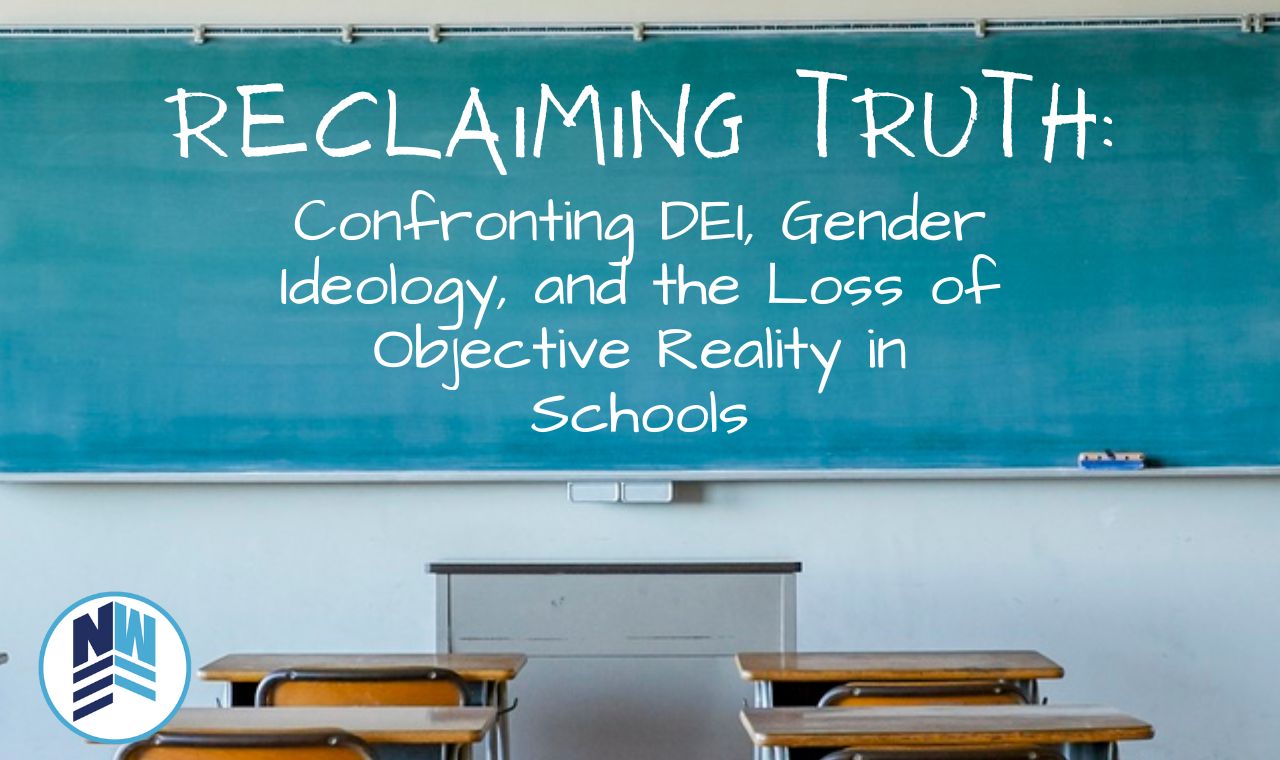
Across America, parents and communities are waking up to an uncomfortable reality: our schools are no longer simply teaching children math, science, and reading. Increasingly, they have become the frontline for ideological battles over race, gender, and identity. These movements, often presented under the banners of “Diversity, Equity, and Inclusion” (DEI) or “gender-affirming education,” claim to pursue justice and compassion. But in practice, they erode truth, confuse children, and replace objective reality with shifting political dogmas.
At the heart of this crisis is a simple but profound question: what is truth?
For centuries, education was rooted in the belief that objective truth exists and that children should be taught to pursue it.
Reading instruction was built on phonics, rooted in the reality of language. History was taught as a record of real events, not a canvas to be rewritten. Morality was grounded in shared values and natural law.
Today, however, truth itself is treated as subjective. Reality is no longer something to be discovered; it’s something to be declared, often by those with the loudest voices or most power.
So, how do we confront these issues productively, reclaiming truth and objectivity for our most vulnerable citizens: our children?
The Rise of DEI and Its Consequences
DEI initiatives claim to fight injustice, but in many schools, they have morphed into programs that divide students by race, pit groups against each other, and frame merit as a barrier to equity.
Even voices sympathetic to addressing inequality are warning that DEI often produces the opposite effect.
“…the diversity, equity, and inclusion agenda…is designed to eliminate racism…” notes Charles Love, in his opinion piece in Newsweek. “But more often than not, these efforts don’t involve raising up those impacted by real racism and real academic gaps between the wealthy and everyone else; they instead drag everyone else down, canceling achievement benchmarks or eliminating standards altogether.”
Instead of teaching children to value character and hard work, DEI often promotes a worldview where identity is destiny and grievances define community.
The result?
A generation of students trained to see themselves not as individuals, but as representatives of categories: oppressed or oppressor, privileged or marginalized.
Gender Ideology and the Assault on Reality
Even more troubling is the spread of radical gender ideology in classrooms. Children as young as kindergarten are being taught that gender is fluid, that biological sex is irrelevant, and that they can choose an identity at will. Schools adopt policies that encourage “social transitions” without parental consent, while curricula push pronoun rituals and gender theory as unquestionable truth.
Alongside this, sexually explicit and age-inappropriate content has been introduced in classrooms to students of all ages. These materials and lessons are not neutral; they shape how children think about themselves, their peers, and even their identities.
As one study has pointed out, “Results indicate that earlier exposure to pornography may significantly influence mental health, life satisfaction, sexual behavior and attitudes, and pornography viewing patterns in adulthood.”
This is not compassion; it’s confusion. Children, who are still developing emotionally and psychologically, are being pressured into accepting ideas that defy biology and common sense. Worse, dissent is silenced. Teachers, parents, and even students who question this ideology are labeled intolerant or hateful.
When schools prioritize ideology over reality, truth becomes the casualty. If a boy can be declared a girl simply by saying so, then biology is irrelevant. If basic biology is irrelevant, then nothing objective remains.
Education built on such shifting sand cannot stand.
Why Truth Matters
“Facts are stubborn things; and whatever may be our wishes, our inclinations, or the dictates of our passions, they cannot alter the state of facts and evidence.” This quote from Founder John Adams highlights the certainty of objective truth.
Truth is not oppressive; truth liberates. Facts aren’t up for debate; they are an immovable reality. A healthy education system acknowledges reality and equips children with the tools to think critically, reason logically, and distinguish right from wrong.
But that requires a commitment to truth, not fantasy.
Historically, truth has been the cornerstone of American education. Our founders understood that a free republic depended on citizens with discernment who could reason.
As George Washington once wrote, “Truth will ultimately prevail where there is pains taken to bring it to light.”
Today, reclaiming truth in education means refusing to bend to ideologies that deny biology, erase history, or redefine morality.
Reclaiming Our Schools and Culture
We cannot rebuild our schools or restore our culture without first grounding ourselves in objective reality. This is where faith, family, morality, responsibility, and community can guide our way forward.
- Faith reminds us that truth is not man-made, but anchored in something higher than ourselves.
- Family ensures that parents, not bureaucrats, are the primary educators of children.
- Morality provides a compass that ideology cannot replace.
- Responsibility calls us to stand firm, even when it is uncomfortable, to speak truth in love.
- Community allows us to join together, resisting destructive trends, building something more substantial in their place.
These ideals work together to counteract the confusion in our schools. They remind us that education is not merely about workforce preparation, but about shaping the next generation of citizens who understand truth, embrace virtue, and value freedom.
A Practical Path Forward
So, what can we do?
- Parents must reassert their rightful role in their children’s education. That means asking hard questions at school board meetings, reviewing classroom materials, and, when necessary, removing children from environments that prioritize ideology over learning.
- Parents should embrace their parental duties at home, not relying on third parties to raise their children in truth. Regardless of whether the children are formally educated at home or in a school, parents have the primary responsibility of ensuring that their children understand right from wrong and the why behind it all.
- Communities must support educational alternatives, such as classical schools, homeschool co-ops, charter schools, and religious schools that refuse to bow to DEI mandates or gender ideology. These are places where truth and excellence can thrive.
- Legislators and policymakers must defend parental rights, restore academic rigor, and ensure that education dollars follow students, not systems. The public education system exists to serve families, not the other way around.
- Voters must hold their legislators accountable and make a difference through calls, letters, and the ballot box.
Reclaiming Truth for the Next Generation
At its core, the fight over DEI and gender ideology in schools is not just about politics. It’s about whether we still believe in truth. If reality can be rewritten at will, if words can mean anything, then children are left adrift in a sea of confusion, and our culture is in a steep decline toward calamity.
But if we anchor education in truth, rooted in faith, guided by morality, strengthened by families, upheld by responsibility, and nurtured in community, then we can raise a generation prepared to reclaim culture, freedom, and hope.
The pushback against harmful ideologies in education is not just a movement; it’s a call to action. We are not passive observers in this cultural struggle. We are parents, teachers, neighbors, and citizens who believe that truth matters, and that without it, freedom cannot survive.
It’s time to reclaim our schools, reclaim our culture, and most of all, reclaim truth.
Learn more about reclaiming education and culture by downloading our new e-book Reclaiming Edcuation and Culture



Fantastic article that’s both interesting and practical.
This website is quickly becoming indispensable.
This article explains the topic very well. The website is useful and reliable.